Sunday, December 11, 2011

Sunday, November 27, 2011
Chemistry Unit Learning Outcomes
Learning for Success – Chemistry Learning Outcomes
- □ I can describe the evidences that led to the development of the atomic model consisting of protons and neutrons (nucleons) and electrons; i.e., Dalton, Thomson, Rutherford, Bohr
- □ I have an awareness of WHMIS guidelines
- □ I can explain the importance of and need for the IUPAC system of naming compounds, in terms of the work that scientists do and the need to communicate clearly and precisely
- □ I can explain, using the periodic table, how and why elements combine to form compounds in specific ratios (Hint: think valence electron pairs)
- □ I can predict formulas and write names for ionic and molecular compounds using a periodic table, a table of ions and IUPAC rules
- □ I can classify ionic and molecular compounds, acids and bases on the basis of their properties; i.e., conductivity, pH, solubility, state
- □ I can relate the molecular structure of simple substances to their properties (e.g., describe how the properties of water are due to the polar nature of water molecules)
- □ I can use IUPAC rules to name common acids
- □ I can use a solubility chart to predict whether an ionic compound will be soluble or insoluble in water
- □ I can describe evidences for chemical changes
- □ I can differentiate between endothermic and exothermic reactions.
- □ I can determine whether or not photosynthesis or cellular respiration are endothermic or exothermic
- □ I can identify situations where chemical reactions as useful in my house and in industry.
- □ I can balance chemical equations
- □ I can identify and classify the following reactions:
- o Formation
- o Decomposition
- o Hydrocarbon combustion
- o Single Replacement
- o Double Replacement
- □ I can predict the products of a reaction when given the reactants
- □ I can define the mole
- □ I can interpret chemical equations in terms of moles of chemical species and relate the mole concept to the law of conservation of mass.
Saturday, November 26, 2011

Monday, November 21, 2011
Balancing Chemical Equations
Here is a video to refresh your memory:
http://www.youtube.com/watch?v=YAutl-G7g4A&feature=related
Here are some websites to practice your skills!
http://www.sciencegeek.net/Chemistry/taters/EquationBalancing.htm
http://education.jlab.org/elementbalancing/index.html (Choose a level that reflects your confidence with this topic)
http://www.youtube.com/watch?v=YAutl-G7g4A&feature=related
Here are some websites to practice your skills!
http://www.sciencegeek.net/Chemistry/taters/EquationBalancing.htm
http://education.jlab.org/elementbalancing/index.html (Choose a level that reflects your confidence with this topic)
Naming Acids
Hi guys,
Sorry for the hiatus from the internet! I hope you all had a lovely Eid holiday. Can you believe that there are only 4 weeks left until the winter holidays? I'll be posting as many resources as I can find that will help you with your upcoming Unit Final. Don't forget, it's coming up on November 30!
Here is a YouTube video from Brightstorm2 about naming acids. It goes over the same rules that we did!
http://www.youtube.com/watch?v=wBRU6gOlq5o
Also, you may want to check our BrightStorm2's other videos about naming ionic compounds and molecular (covalent) compounds.
I hope it helps!
Ms. Camille
Sorry for the hiatus from the internet! I hope you all had a lovely Eid holiday. Can you believe that there are only 4 weeks left until the winter holidays? I'll be posting as many resources as I can find that will help you with your upcoming Unit Final. Don't forget, it's coming up on November 30!
Here is a YouTube video from Brightstorm2 about naming acids. It goes over the same rules that we did!
http://www.youtube.com/watch?v=wBRU6gOlq5o
Also, you may want to check our BrightStorm2's other videos about naming ionic compounds and molecular (covalent) compounds.
I hope it helps!
Ms. Camille
Saturday, October 29, 2011
Properties of water
Here's a decent video about water's unique properties. Watch the video and answer the following questions:

- Describe the shape of a water molecule
- What is cohesion?
- What property water molecule makes it cohesive?
- What property of water is attributed to its cohesive nature? (hint: think back to the paper clip activity!)
- What is adhesion?
- What is capillary action? Does it occur because of water's cohesive nature or adhesive nature?
- How does a droplet of water compare to a droplet of alcohol? Which has stronger cohesive forces?
- Does mercury have more or less cohesion than water?
- Go back into your notes or to p. 75 of your textbook: What are other terms used to describe cohesive and adhesive forces?

Saturday, October 8, 2011
Transition Metal Cations
So far, we have only discussed 4 families of elements: the alkali metals, the alkaline earth metals, the halogens, and the noble/inert gases. Now we are going to pay attention to all those elements in between!
Take a look at groups 3 to 12. They are all metals, right? Well, we group these elements into a category called the "transition metals." This isn't a chemical family; in fact, transition metals really only have a few things in common:
1) They are all metals
2) They all have 4 or more electron orbitals (these are called d-orbitals)
3) They all form cations in ionic compounds

Because of their unique d-orbitals, these transition metals don't follow the same patterns of other metals we've learned about. It is difficult to predict what cation a transition metal will form and some transition metals can form two different cations! Let's break it down...
Take a look at groups 3 to 12. They are all metals, right? Well, we group these elements into a category called the "transition metals." This isn't a chemical family; in fact, transition metals really only have a few things in common:
1) They are all metals
2) They all have 4 or more electron orbitals (these are called d-orbitals)
3) They all form cations in ionic compounds

Because of their unique d-orbitals, these transition metals don't follow the same patterns of other metals we've learned about. It is difficult to predict what cation a transition metal will form and some transition metals can form two different cations! Let's break it down...
- Take a look at your Periodic Table of the elements. Can you identify the transition metals?
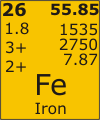
- Find the element iron (period 4, group 8). You may notice that there are two integers included in its cell. +3, +2. These integers represent the cations that iron can form in an ionic compound. So, you could have Fe3+ or Fe2+. This means that iron can give away 3 valence electrons (Fe3+) or two valence electrons (Fe2+). What are the two cation charges for palladium (period 5, group 10)?
- You'll notice that some elements only form one cation (Zn2+, for example) and that others form two (Cu2+ or Cu1+). If there are two possible cations, the first integer represents the cation it is most likely to form.
- FeO
- Fe2O3
- Fe2+ and O2- will create FeO
- 2 x Fe3+ (total positive charges = 6) and 3 x O2- (total negative charges = 6) will create Fe2O3
- http://www.bbc.co.uk/schools/gcsebitesize/science/edexcel/patterns/transitionmetalsrev1.shtml (please note that this website labels the groups on the periodic table different from what we have been learning. Transition metals are in groups 3-12.)
Subscribe to:
Posts (Atom)