So far, we have only discussed 4 families of elements: the alkali metals, the alkaline earth metals, the halogens, and the noble/inert gases. Now we are going to pay attention to all those elements in between!
Take a look at groups 3 to 12. They are all metals, right? Well, we group these elements into a category called the "transition metals." This isn't a chemical family; in fact, transition metals really only have a few things in common:
1) They are all metals
2) They all have 4 or more electron orbitals (these are called d-orbitals)
3) They all form cations in ionic compounds

Because of their unique d-orbitals, these transition metals don't follow the same patterns of other metals we've learned about. It is difficult to predict what cation a transition metal will form and some transition metals can form two different cations! Let's break it down...
Take a look at groups 3 to 12. They are all metals, right? Well, we group these elements into a category called the "transition metals." This isn't a chemical family; in fact, transition metals really only have a few things in common:
1) They are all metals
2) They all have 4 or more electron orbitals (these are called d-orbitals)
3) They all form cations in ionic compounds

Because of their unique d-orbitals, these transition metals don't follow the same patterns of other metals we've learned about. It is difficult to predict what cation a transition metal will form and some transition metals can form two different cations! Let's break it down...
- Take a look at your Periodic Table of the elements. Can you identify the transition metals?
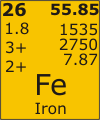
- Find the element iron (period 4, group 8). You may notice that there are two integers included in its cell. +3, +2. These integers represent the cations that iron can form in an ionic compound. So, you could have Fe3+ or Fe2+. This means that iron can give away 3 valence electrons (Fe3+) or two valence electrons (Fe2+). What are the two cation charges for palladium (period 5, group 10)?
- You'll notice that some elements only form one cation (Zn2+, for example) and that others form two (Cu2+ or Cu1+). If there are two possible cations, the first integer represents the cation it is most likely to form.
- FeO
- Fe2O3
- Fe2+ and O2- will create FeO
- 2 x Fe3+ (total positive charges = 6) and 3 x O2- (total negative charges = 6) will create Fe2O3
- http://www.bbc.co.uk/schools/gcsebitesize/science/edexcel/patterns/transitionmetalsrev1.shtml (please note that this website labels the groups on the periodic table different from what we have been learning. Transition metals are in groups 3-12.)
