Sunday, March 11, 2012

Transport Across the Cell Membrane

Here is a nice flash animation that shows passive transport (diffusion, facilitated diffusion, and osmosis) and active transport.

http://www.northland.cc.mn.us/biology/biology1111/animations/transport1.html


Tuesday, February 28, 2012

Click me: The scale of the universe as we know it!

I discovered this gem of a website over the weekend.  It's quite possibly one of the coolest websites I have ever seen.  It shows you just how small the smallest of things really is and just how large the universe is!  Check it out:

http://htwins.net/scale2/

Understanding semi permeable membranes can save lives!

HIV Treatments
HIV, of the Human Immunodeficiency Virus, affects just under 1% of the world's population.  Spread through bodily fluids, this virus infects the important cells of your immune system.  A weakened immune system can lead to life threatening infections and allow certain types of cancer to divide and grow unchecked.  People with HIV-1 usually develop AIDS.

The virus enters your cells by attaching itself to a transport proteins in the cell membrane and uses that protein to inject its genetic material into the cell.  New treatments have been developed to prevent this from happening.  A drug called an inhibitor can bind to these transport proteins before the HIV virus does.  This will slow the spread of the virus' genes (remember, virus can't multiply on their own....they can only infect human cells and "hope" for those cells to divide).

Without our knowledge of the different kinds of transport proteins in cell membranes and an understanding of how they work, this treatment would not have been possible!  Now we are able to improve the quality of life (and prolong the lives of) numerous HIV suffers around the world.

Desalination
The world is currently facing a fresh water shortage and desalination is many countries' solution to this problem.  As it were, we would not be living in Qatar if it weren't for desalination!  There are two types of desalination.  The first is thermal desalination where seawater is boiled and the evaporate (which is salt-less) is collected.  This process is very energy intensive as water has a very high heat capacity (aka. it takes a lot of energy to heat it up even slightly).  The second process, which is a fairly new technology, is called membrane desalination and, you guessed it, it uses a selectively permeable membrane.

Osmosis is a process where water will flow from a hypotonic solution to a hypertonic solution.  This movement of water particles creates pressure (this is called osmotic pressure and it is a force that pushes water particles across a membrane).  In the membrane desalination process, scientists use this principal!  They push water particles across a semi-permeable membrane thus separating it from the salt.  The salt can't get through the membrane, it's too big!!  So this process will be the opposite of osmosis... water will move from a hypertonic solution (salty seawater) to a hypotonic solution (pure drinking water) across a semi permeable membrane.  Therefore, it's called reverse osmosis.  Heard of it before?  If not, take a look at some of your bottled water and you'll find the word eventually!  The reverse osmosis process is not just used in desalination, it's also used to purify any kinds of water with dissolved solutes.

Here's a diagram comparing osmosis (diagram on the left) and reverse osmosis used in desalination (diagram on the right).


Dialysis
Your kidneys are amazing at membrane transport.  They rely heavily on diffusion in order to purify your blood and get rid of all those yucky wastes!  Unfortunately some people's kidneys fail.  If it were not for dialysis their blood would quickly reach toxic levels and result in death.  

Simply, dialysis has two parts: a semi permeable membrane and dialysate, a fluid that has just the right concentration of solutes to allow the diffusion of appropriate molecules in appropriate concentrations.  The patient's blood is removed from his/her body and filtered through a dialysis machine containing these two items.  Particles in the blood flow across the membrane following a concentration gradient, and into the dialysate.  This is simple diffusion!  Clean blood is then returned to the patient's body.

Here is a simplified diagram of the dialysis process:
  

The Cell Membrane & Transport

Here's a fun little game that will help you review the different parts of the cell membrane and also examine the role these parts play in transporting various molecules
http://www.quickflashgames.com/games/cell-defense-the-plasma-membrane/

Here is a nice little slideshow that does a great job explaining transport across cell membranes.  The section on active transport goes into a bit too much detail so don't sweat it if the concepts start seeming really unfamiliar!
http://www.wiley.com/college/boyer/0470003790/animations/membrane_transport/membrane_transport.htm

Identifying the parts of a cell

There are loads of good websites out there for learning about the various organelles in a cell.  My personal favorite is cellsalive!  There is also this website however it goes into a bit more detail than what you are required to know (as per your curriculum).  But, if you feel like you want to learn even more about the cell, go for it!  Just to remind you of you learning outcomes, you need to be able to identify and describe the following organelles:

  • cell membrane
  • nucleus
  • lysosome
  • vacuole
  • mitochondrion
  • endoplasmic reticulum
  • golgi apparatus
  • ribsosome
  • chloroplast (plant cell only)
  • cell wall (plant cell only)

Tuesday, January 10, 2012

Speed, Velocity, and Acceleration

Hi folks!

Thus far we have been learning about scalar and vector quantities.  The scalar quantities that we have described are distance and speed.  The vector quantities that we have described at displacement, velocity, and now acceleration.  Remember in all vector quantities direction plays a very important role!  In order to communicate direction we have used points on a compass (NSEW), and positive and negative integers.  Remember, negative integers usually imply an opposing direction.

To recap what we have learned about these concepts and for a brief introduction to acceleration, please check out this video!

Also, another good (and very cute) introductory video to acceleration can be found here.  You won't regret watching this one!

Enjoy!

Ms. Camille

Sunday, December 11, 2011

Scalars and Vectors

Hey Grade 10's!

Here is the video we watched in class about scalars and vectors.

Enjoy!

Ms. Camille

Sunday, November 27, 2011

Chemistry Unit Learning Outcomes


Learning for Success – Chemistry Learning Outcomes
  • □       I can describe the evidences that led to the development of the atomic model consisting of protons and neutrons (nucleons) and electrons; i.e., Dalton, Thomson, Rutherford, Bohr
  • □       I have an awareness of WHMIS guidelines
  • □       I can explain the importance of and need for the IUPAC system of naming compounds, in terms of the work that scientists do and the need to communicate clearly and precisely
  • □       I can explain, using the periodic table, how and why elements combine to form compounds in specific ratios (Hint: think valence electron pairs)
  • □       I can predict formulas and write names for ionic and molecular compounds using a periodic table, a table of ions and IUPAC rules
  • □       I can classify ionic and molecular compounds, acids and bases on the basis of their properties; i.e., conductivity, pH, solubility, state
  • □       I can relate the molecular structure of simple substances to their properties (e.g., describe how the properties of water are due to the polar nature of water molecules)
  • □       I can use IUPAC rules to name common acids
  • □       I can use a solubility chart to predict whether an ionic compound will be soluble or insoluble in water
  • □       I can describe evidences for chemical changes
  • □       I can differentiate between endothermic and exothermic reactions.
  • □       I can determine whether or not photosynthesis or cellular respiration are endothermic or exothermic
  • □       I can identify situations where chemical reactions as useful in my house and in industry.
  • □       I can balance chemical equations
  • □       I can identify and classify the following reactions:
  • o   Formation
  • o   Decomposition
  • o   Hydrocarbon combustion
  • o   Single Replacement
  • o   Double Replacement
  • □       I can predict the products of a reaction when given the reactants
  • □       I can define the mole
  • □       I can interpret chemical equations in terms of moles of chemical species and relate the mole concept to the law of conservation of mass.

Saturday, November 26, 2011

Monday, November 21, 2011

Balancing Chemical Equations

Here is a video to refresh your memory:

http://www.youtube.com/watch?v=YAutl-G7g4A&feature=related

Here are some websites to practice your skills!

http://www.sciencegeek.net/Chemistry/taters/EquationBalancing.htm
http://education.jlab.org/elementbalancing/index.html (Choose a level that reflects your confidence with this topic)

Naming Acids

Hi guys,

Sorry for the hiatus from the internet!  I hope you all had a lovely Eid holiday.  Can you believe that there are only 4 weeks left until the winter holidays?  I'll be posting as many resources as I can find that will help you with your upcoming Unit Final.  Don't forget, it's coming up on November 30!

Here is a YouTube video from Brightstorm2 about naming acids.  It goes over the same rules that we did!

http://www.youtube.com/watch?v=wBRU6gOlq5o

Also, you may want to check our BrightStorm2's other videos about naming ionic compounds and molecular (covalent) compounds.

I hope it helps!

Ms. Camille

Saturday, October 29, 2011

Properties of water

Here's a decent video about water's unique properties. Watch the video and answer the following questions:
  1. Describe the shape of a water molecule
  2. What is cohesion? 
  3. What property water molecule makes it cohesive?
  4. What property of water is attributed to its cohesive nature?  (hint: think back to the paper clip activity!)
  5. What is adhesion?
  6. What is capillary action?  Does it occur because of water's cohesive nature or adhesive nature?
  7. How does a droplet of water compare to a droplet of alcohol?  Which has stronger cohesive forces?
  8. Does mercury have more or less cohesion than water?
  9. Go back into your notes or to p. 75 of your textbook:  What are other terms used to describe cohesive and adhesive forces?
If you'd like, fill out a diagram or table that lists water's cohesive and adhesive properties.


Saturday, October 8, 2011

Transition Metal Cations

So far, we have only discussed 4 families of elements: the alkali metals, the alkaline earth metals, the halogens, and the noble/inert gases.  Now we are going to pay attention to all those elements in between!

Take a look at groups 3 to 12.  They are all metals, right?  Well, we group these elements into a category called the "transition metals."  This isn't a chemical family; in fact, transition metals really only have a few things in common:

1) They are all metals
2) They all have 4 or more electron orbitals (these are called d-orbitals)
3) They all form cations in ionic compounds


Because of their unique d-orbitals, these transition metals don't follow the same patterns of other metals we've learned about.  It is difficult to predict what cation a transition metal will form and some transition metals can form two different cations!  Let's break it down...

  • Take a look at your Periodic Table of the elements.  Can you identify the transition metals?
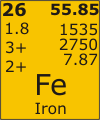
  • Find the element iron (period 4, group 8).  You may notice that there are two integers included in its cell.  +3, +2.  These integers represent the cations that iron can form in an ionic compound.  So, you could have Fe3+ or Fe2+.  This means that iron can give away 3 valence electrons (Fe3+) or two valence electrons (Fe2+).  What are the two cation charges for palladium (period 5, group 10)?

  • You'll notice that some elements only form one cation (Zn2+, for example) and that others form two (Cu2+ or Cu1+).  If there are two possible cations, the first integer represents the cation it is most likely to form.
So, take a look at the following two examples and see if you cannot determine which cation of iron is used in each:
  1. FeO
  2. Fe2O3
Figure it out?  First thing you should ask is "what is the charge of the anion?"  Oxygen has 6 valence electrons and can receive two more.  Therefore, in an ionic compound, oxygen is always O2-.  Now you have to figure out the charges of the cations which will create a stable (no charge) ionic compound.
  1. Fe2+  and O2-  will create FeO
  2. 2 x Fe3+ (total positive charges = 6) and 3 x O2- (total negative charges = 6) will create Fe2O3
More about transition metals:
  • http://www.bbc.co.uk/schools/gcsebitesize/science/edexcel/patterns/transitionmetalsrev1.shtml  (please note that this website labels the groups on the periodic table different from what we have been learning.  Transition metals are in groups 3-12.)
  •  

Thursday, October 6, 2011

Ionic Compounds

What I need to know about ionic compounds:

  • Formed between metallic and non-metallic elements
  • Electrons are transferred  from the metal to the non-metal.  This only happens between the valence energy shells (outer orbitals) of the atoms.
  • When this occurs, both atoms become ions (charged)
  • The metal, having lost negative electrons, is now positively charged and is called a cation.
  • The non-metal, having gained negative electrons, is now negatively charged and is called an anion.
  • These ions will combine in proportions that allow the metals to give away all their unpaired electrons and the non-metals to acquire a full octet of electrons.
Extra reading:
  • Ions: http://www.bbc.co.uk/schools/gcsebitesize/science/add_aqa/atomic/ionicrev1.shtml
  • Ionic Bonds: http://www.teachersdomain.org/resource/lsps07.sci.phys.matter.ionicbonding/
  • Chemical bonds: http://www.teachersdomain.org/resource/lsps07.sci.phys.matter.chembonds/
  • Chemical bonds: http://www.visionlearning.com/library/module_viewer.php?mid=55

Sunday, September 18, 2011

About Orbitals

Please watch this video for homework tonight.  It is a little advanced so try not to feel overwhelmed.  Electron orbitals are abstract and therefore a bit confusing!

The following questions should help guide your learning.

  1. Which scientist devised the concept of energy levels and orbitals?
  2. What subatomic particle exists in orbitals?
  3. Are these orbitals 2-Dimensional or 3-Dimensional?
  4. Are they well defined paths?
  5. What is energy?
  6. What makes an electron “excited?”
  7. Each period in the periodic table will have ________ energy shell
  8. How many elements are in the first period?  What are they? How many protons & electrons do they each have?

Wednesday, September 14, 2011

Just to get us started...


Below is a great website that provides a basic overview of the concepts we will be learning about in this next section.  Make sure you look at the section called "Atomic Basics".


Also, make sure you comment on my welcome message below if you haven't done so already! 

Tuesday, September 13, 2011

Welcome to Science 10

Welcome to Science 10 at QCS!

This year, I will be using a blog to communicate with you about the course.  On this website I will post links and information that will assist you in the completion of this course.  Additionally, you are encouraged to post to this blog via the comment feature available to each blog posting.  You can provide the class with links related to the class or you can ask a question of myself and/or the class.  These questions could be about assignments or concepts.

When posting please be respectful of the following:
  1. Your peers and your teacher
  2. Your school
  3. The ideas and beliefs of others
  4. The country within which we live
 As such, I ask that you only post material related to the content of this course.  I also ask that you use formal and appropriate language.  Any instant messaging slang will be deleted from the blog.

Please indicate that you have read this by supplying your name (first name only please) and include something that you hope to get out of this course.

I look forward to working with you!  Ms. Camille